
Berkeley County Directory Runs
Martinsburg is the center of Berkeley County city directory research, but its surviving runs are uneven. The repositories complement one another. A missing year in one catalog may be on another reel or in a local room. Ask for the precise year and publisher because similarly dated volumes may be duplicates.
| Collection | Years located | Where held | Access |
|---|---|---|---|
| R.L. Polk Martinsburg directories | 1913–14, 1915–16, 1918–20, 1922, 1925, 1927, 1929, 1932, 1934–35 | FamilySearch | Catalog and microfilm; an account or affiliate may be required |
| Martinsburg directories | 1915–16, 1922, 1957, 1963, uneven runs from 1967–92, 1995–2002, 2004–10, 2012–16 | WV Archives & History | Reading-room or library access |
| Regional microfilm | 1898–99, selected years from 1925–38, 1950, 1955–56 | WVU Regional History Center | Request an exact reel |
| Telephone directories | Exact years not established | WV Archives & History | Martinsburg, Falling Waters, Hedgesville, and Inwood |
Check the WV Archives directory list, FamilySearch Martinsburg catalog, and WVU microfilm list together. These lists show holdings, not proof that every Berkeley County household was printed.
Berkeley County's Beall Room
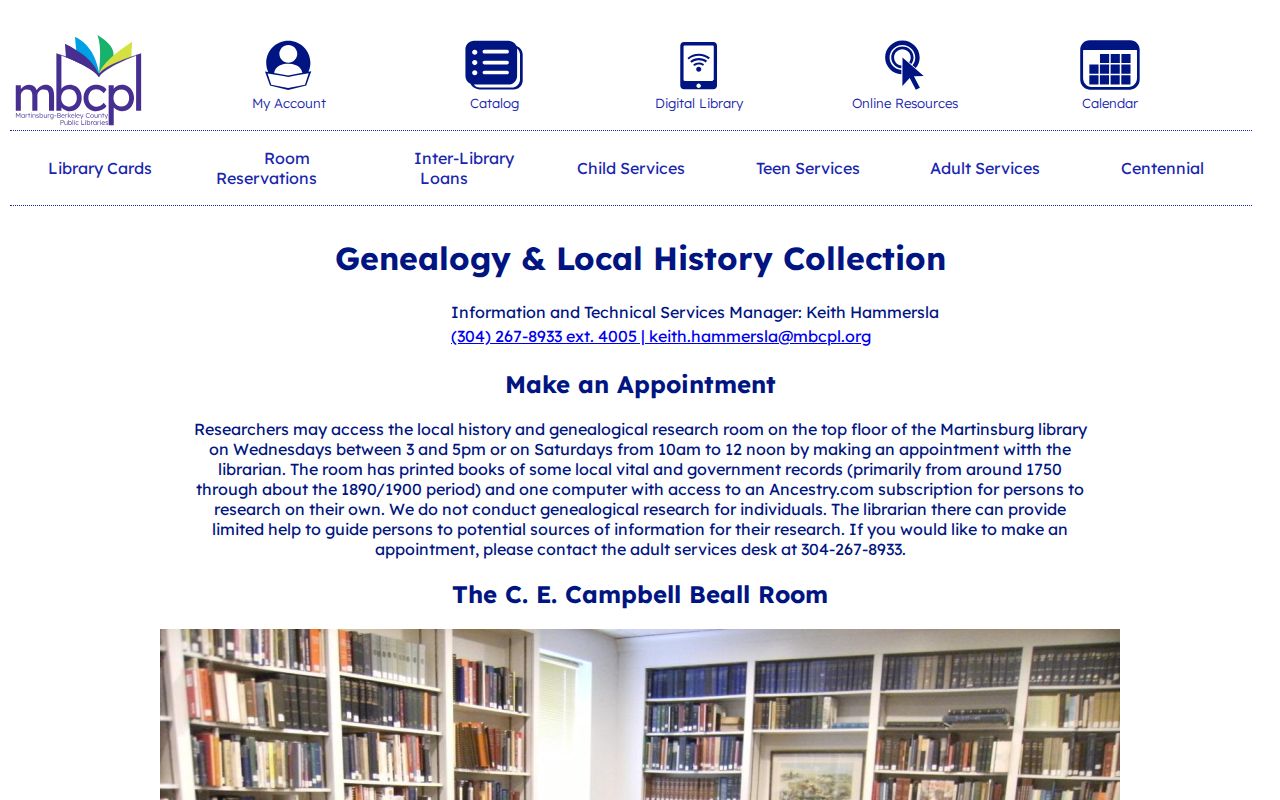
The C.E. Campbell Beall Room is on the top floor of the Martinsburg library. Reservations are offered Wednesdays from 3 to 5 p.m. and Saturdays from 10 a.m. to noon; call 304-267-8933. Its local-history focus is roughly 1750 through 1890 or 1900, with city directories joined by cemetery, tax, census, deed, land, vital, obituary, and family files.
The room has one Ancestry computer, HeritageQuest access, and links to West Virginia Vital Research Records. Staff provide direction but do not conduct a full genealogy project. Black-and-white copies cost 20 cents and color copies 50 cents. Newspaper microfilm for Berkeley, Jefferson, and Morgan counties spans 1791 to the present; pages may be printed for 20 cents or saved to a user's USB drive.
The library's local-history page sets out the access choices.
Read Berkeley County Directory Entries
A city directory entry is a dated lead. Depending on publisher and year, it may show a person, spouse, occupation, telephone, business, and street address. No stable scanned local entry or Berkeley County abbreviation key was found, so symbols must be read from the key printed in the volume. Never expand an initial or short form by guesswork.
| Name | Copy initials, spelling, and household notation exactly. |
|---|---|
| Work or business | Record the printed label as context for that year. |
| Address | Keep the house number, street form, apartment, or boarding mark. |
| Household marks | Note spouse, widow, owner, renter, or boarder only when the key defines the symbol. |
| Citation | Save year, publisher, page, section, and repository. |
- Criss-cross directory
- A section arranged by street and house number rather than surname.
- Householder index
- An address-led list used to move from a place to a named person.
- Abbreviation key
- The volume's own explanation of short forms and symbols; photograph it first.
An omission does not prove that a home stood empty. Coverage could exclude a rural area, an unlisted telephone, a boarder, or a newly moved family.
Search Berkeley County by Street
Alphabetical pages answer where a named person lived. Street and criss-cross pages reverse the question and ask who was printed at a number. Search both when possible. Nearby addresses may suggest relatives, a boarding arrangement, or a numbering shift, but closeness does not establish a relationship.
The Library of Congress city-directory research guide recognizes name, address, criss-cross, telephone, business, and year requests. For present-day parcel work, use the Berkeley County street directory workflow instead of treating historical print as current.
Note: Preserve the directory's street spelling, then add a separate modern form so later searches do not erase the source wording.
Martinsburg Directories Meet Sanborn Maps
A name and number tell only part of the story. Fire-insurance maps show a block, building footprint, street pattern, and structural change. WVU lists digitized Martinsburg Sanborn maps for 1885, 1891, 1897, 1902, 1907, and 1913. The Library of Congress preserves fifteen sheets from August 1907.
Pair the nearest city directory year with a map sheet, but state the finding with care. A map may show that a structure existed; it does not name all occupants. A modern parcel may combine or divide early lots. Compare intersections, building outlines, and lot shapes before assuming the current house number is unchanged.
| 1885–1902 | Early sheets can test whether a building and street layout predate an entry. |
|---|---|
| 1907 | Fifteen LOC sheets provide a detailed Martinsburg block view. |
| 1913 | The map can be paired closely with the earliest located Polk reels. |
Trace Berkeley County Families
City directories fill years between federal census releases. They work best as a sequence. The federal census is released after 72 years and uses enumeration geography that does not match today's ZIP codes.
- Find the first likely name in an available volume and copy the entry exactly.
- Check the next available years in both directions. Record each move and spelling change.
- Turn to the street section to test the address and nearby surnames.
- Compare the nearest released census for household members, allowing for a different enumeration area.
- Add a deed or tax record for ownership and a newspaper, obituary, or probate file for a move or death.
If the person vanishes, test nearby editions, initials, maiden or married names, and the communities of Hedgesville, Inwood, Falling Waters, and rural Berkeley County. A gap remains a gap until another dated source closes it.
Berkeley County Record Gaps
Several disruptions make a negative result uncertain. Berkeley County has many gaps, especially during the Civil War years. The courthouse burned in 1922, and a temporary courthouse burned in 1975 after records had been moved. FamilySearch also warns that early deed books are badly damaged and have missing pages.
WPA transcriptions from the 1930s may bridge part of the loss, but they do not show that an original set was complete. Move from the custodian to State Archives microfilm, then library newspapers and directories, catalog notes, and Society files. State which source was checked rather than declaring that no record existed.
Note: A blank index result is evidence about that index, not final proof about a Berkeley County resident.
Berkeley County Directory Help
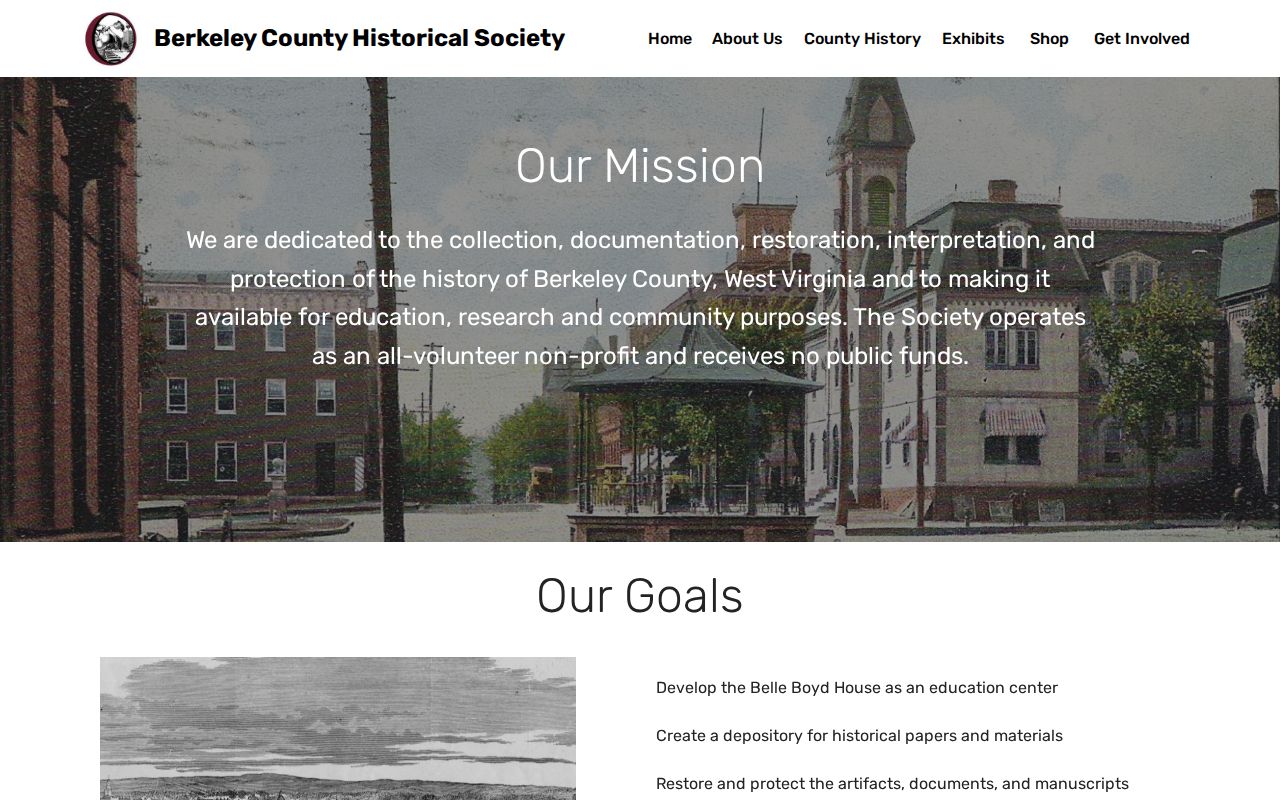
The Historic Berkeley County Society operates an all-volunteer Archives & Research Center at 136 E Race Street in Martinsburg. Access is by appointment, and requests may be emailed to bchs@historicberkeley.org. Its public site did not provide a fee schedule, so ask before ordering research or copies.
The Society's official page explains its local collections and contact route.
West Virginia Archives & History supplies a reading-room and mail route. FamilySearch may require an account or affiliate library for images, though its catalog identifies reel provenance. Online catalogs, reading rooms, microfilm, library copies, Society appointments, email, and archive mail cover the documented Berkeley County city directory access channels.
Ask a repository to check both the alphabetical and street sections. Supply the surname, address form, community, and a short year range. Mention Falling Waters, Hedgesville, or Inwood at once because telephone holdings extend beyond Martinsburg even though exact runs are not documented. For a copy, request the title page and abbreviation key with the entry. Those pages establish the edition and meaning of its marks. A full citation also lets another researcher repeat the search without relying on a transcription.