
Berkeley County Address Eras
Different sources answer different parts of a Berkeley County address history. Begin with the source closest to the target period. Modern parcel data can point to a deed reference, while directories and census schedules add the household layer. Earlier searches may depend on tract descriptions rather than a house number.
| Source | Years it covers | Where held | What it shows |
|---|---|---|---|
| Assessment and parcel card | Current; online start year not stated | Assessor and MapWV | Owner, mailing and physical fields, PID, deed reference, legal description |
| Recorded deeds | Online page says deeds from 1945; 2025 agreement says from 1970 | Berkeley County Clerk | Grantor, grantee, instrument, book/page, and land description |
| Historic deed books | 1772–1926 catalog context | FamilySearch, State Archives, clerk | Earlier ownership chain; damaged books and missing pages |
| Martinsburg directories | 1898–2016 in uneven runs | Library, Archives, WVU, FamilySearch | Dated named occupants where included |
| Federal census | Released after 72 years | NARA and library databases | Household members in historical enumeration geography |
| Sanborn maps | 1885, 1891, 1897, 1902, 1907, 1913 | WVU and Library of Congress | Structures and blocks, not residents |
Permit search is another modern lead, but no official start year was found. The county portal can search permit number, owner, subdivision, and lot; a permit names an applicant or owner at a point in time, not every person in the home.
Start Berkeley County Previous Residents
Search the current address through the county address tools or MapWV parcel viewer. Save the parcel ID, or PID, and note the district, map, parcel, suffix, physical address, mailing address, legal description, and deed book/page. These fields can disagree without any error. A tax mailing address receives notices; a physical or situs address describes location; a legal description identifies the land.
The official sample assessment demonstrates the distinction.
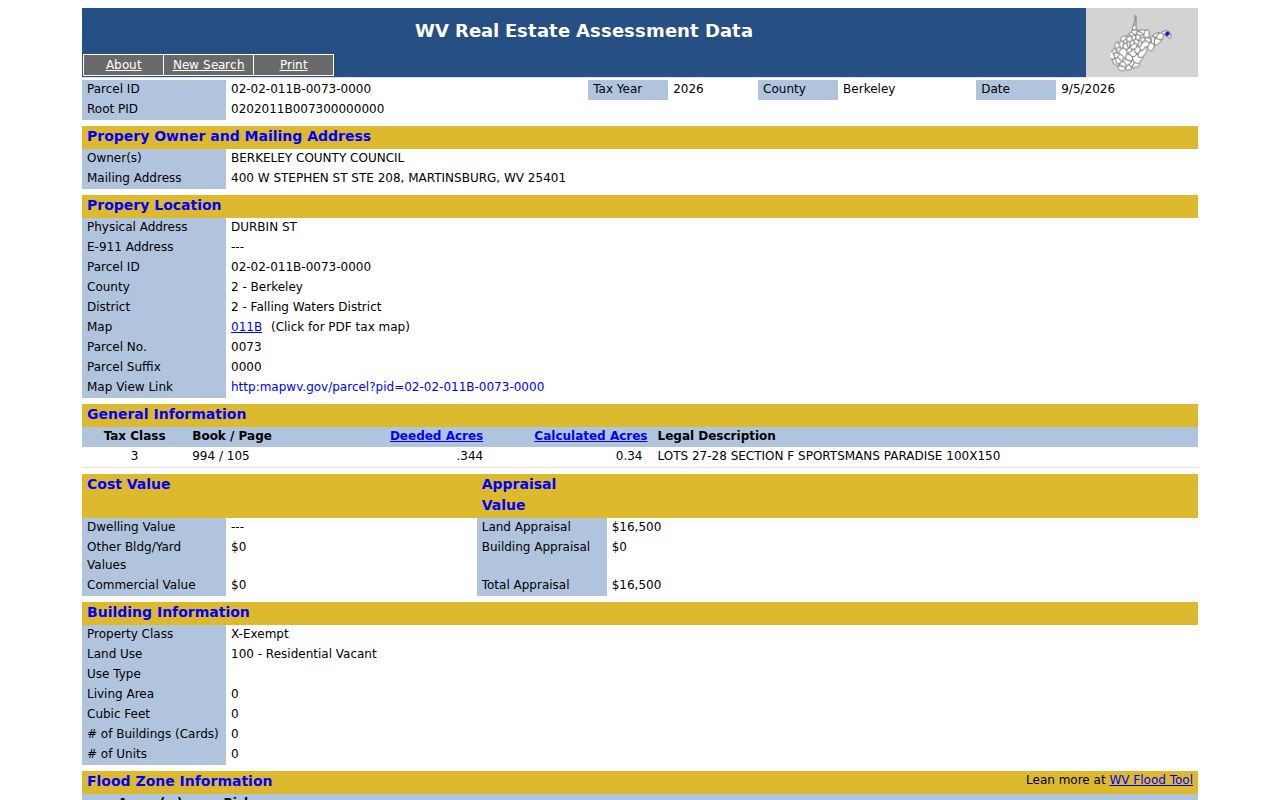
The sample is a county-owned vacant parcel, not evidence about a private person. Its value is the field structure. Carry the PID and legal description forward because street labels can change.
Walk Berkeley County's Deed Chain
The Electronic Record Search is a registered virtual courthouse. The current county page states deeds from 1945 to the present, while the 2025 user agreement says 1970 forward. Confirm the true electronic range with the County Clerk. Regular access is listed at $15 per month, plus $1.50 for the first two pages and $1 for each later page.
- Take the current owner, legal description, and book/page from the assessment.
- Retrieve that purchase deed and copy its grantor, grantee, dates, acreage, and prior reference.
- Search the seller as a former grantee to find the seller's purchase.
- Compare every lot, section, subdivision, survey, and acreage reference before moving back.
- When the online index ends, request the deed book from the clerk, Archives, or FamilySearch microfilm.
- Grantor and grantee
- The grantor transfers an interest; the grantee receives it.
- Chain of title
- The linked sequence of instruments through which ownership passed.
- Legal description
- The land wording in a deed, often based on lots, surveys, tracts, or bounds rather than a street address.
The Berkeley deed catalog covers 1772–1926 on 54 reels. Books 1 through 4 are badly damaged and have missing pages, so an early chain may require another source.
Separate Berkeley County Record Roles
Ownership is only one layer. An assessed owner may live elsewhere, and a resident may never appear on a deed. A named tax taxpayer can be an owner, estate, trust, business, fiduciary, or mailing party. A city directory may include a renter or telephone subscriber who has no land interest. Previous residents should therefore be reported by source role and date.
| Deed party | A person or entity named in a land instrument. |
|---|---|
| Assessed owner | The owner recorded for the assessment cycle. |
| Mailing party | The destination for tax notice, not necessarily the property. |
| Directory occupant | A person printed at an address in that edition. |
| Census household member | A person enumerated there on the census reference date. |
A sequence becomes stronger when independent records agree. It should still say “listed at,” “assessed to,” or “named as grantee,” rather than merge those claims into one.
Pair Berkeley County Household Records
Once the ownership chain has dates, search the nearest Martinsburg directory runs and released census schedules. The directory collection itself, including the exact uneven holdings, is detailed on the Berkeley County city directory page. For this backward address trail, the task is to test the same place across time.
- Search an available directory year by street and house number, then copy each name exactly.
- Check the alphabetical section for spouse, telephone, occupation, or a second address.
- Repeat in the next available years, allowing for changes in number or street form.
- Compare the nearest released census by historical enumeration geography, not modern ZIP code.
- Use an obituary, newspaper, death index, or probate file to explain a departure or transfer to heirs.
The C.E. Campbell Beall Room has local directories, obituary indexes, family files, and newspapers on microfilm from 1791 to the present. Access is by reservation, and staff provide guidance rather than a full research service. Archive catalogs, FamilySearch reels, Society appointments, and library copies cover the other documented access routes.
Map Berkeley County Past Residents
Martinsburg Sanborn maps can date a building and show its block setting. WVU lists 1885, 1891, 1897, 1902, 1907, and 1913; the Library of Congress holds fifteen sheets from August 1907. Compare the structure footprint, street layout, lot, and cross streets with a directory year. The map does not name every person who lived there.
Before modern numbers, the Berkeley County House Tax of 1798 and courthouse survey files offer another path. An old record may identify a tract, farm, adjacent landowner, route, or lot instead of today's street. Bridge it through legal descriptions, plats, deeds, directory labels, and maps. No official source documented a countywide historical renumbering year, so do not invent one.
Note: Treat a matching Sanborn building as spatial context until a dated name record links a person to that address.
Berkeley County's Missing Pages
Berkeley County's courthouse record story has several breaks. Civil War-era records contain many gaps. A courthouse fire occurred in 1922, and a temporary courthouse burned in 1975 after records had been moved. FamilySearch flags damaged early deed books and missing order-book pages. These facts change the search method for previous residents.
Use a negative-finding ladder: ask the current custodian, check State Archives microfilm, review WPA transcriptions or abstracts, search library newspapers and directories, read FamilySearch catalog notes, and contact the local historical society. WPA work from the 1930s can bridge a gap but cannot prove the original was complete.
Research use. Trace Berkeley County homes for family history, property history, heirs, or personal curiosity. Never use address records to track, threaten, or harass a living person.
Continue Berkeley County Address Research
The Berkeley County Clerk is at 400 W Stephen Street, Suite 103, Martinsburg, and can be reached at 304-264-1927. The 2024 move matters because older instructions may point to King Street. Ask the clerk about a book, page, copy, or index range with enough detail to identify the record.
For older work, State Archives holds Berkeley deed indexes from 1772–1926, deeds from 1772–1901, surveys, land books, wills, estate settlements, statements of heirs, and order books. The Historic Berkeley County Society offers appointment and email research access. The library provides in-person microfilm, copy, and USB routes. When no public index answers the question, a narrow request to the right custodian under West Virginia FOIA is a fallback, but it does not override a confidential-record rule.
End the trail with a dated research note: the last confirmed owner or occupant, the source checked, the unresolved gap, and the exact office, reel, or collection that could extend it.